
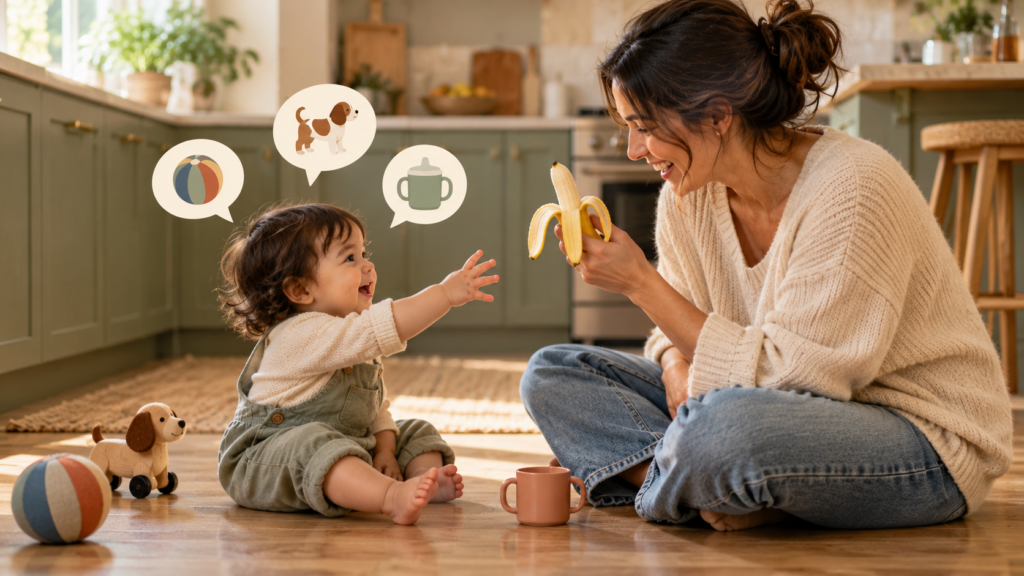
The best way to encourage toddler speech is to talk with your child, not at them, throughout the ordinary moments of the day. Toddlers learn language from responsive, back-and-forth interaction, so the most powerful tools are already in your home: your voice, a few books, and some patience. This guide covers simple toddler language activities and habits for speech development at home, plus signs that it is time to seek extra help.
How toddlers learn to talk
For a broader picture of movement, learning and social skills, see our guide to toddler developmental milestones from ages 1 to 3.
Before speaking, children spend months absorbing sounds, watching faces and linking words with objects. Understanding (receptive language) runs ahead of speaking (expressive language), so a child who says little may still understand a lot. Most toddlers say a handful of words by 12–18 months, and many have 50 or more words and begin combining two words by about 24 months. The range is wide, and boys and girls, first children and later children, bilingual and monolingual children can all follow different timelines.
8 ways to encourage toddler talking at home
- Narrate your day. Describe what you do and see: “I’m cutting the banana. Now it’s in your bowl.” This is often called self-talk and gives your child a steady stream of useful words.
- Describe what your child does. “You’re pushing the red car! Vroom!” Linking words to their own actions makes the words stick.
- Pause and wait. After you ask or comment, count to five silently. Toddlers need extra time to find sounds. Jumping in too fast can shut the turn down.
- Expand their words. If your child says “dog,” reply “Yes, a big brown dog!” Add one or two words more than they used, without correcting them.
- Offer choices. “Apple or banana?” encourages a word, a point or a sound, and builds a natural reason to talk.
- Read together every day. Point to pictures, name things and let your child turn pages. Repeated favourite books are good: repetition is how words are learned.
- Sing and use rhymes. Songs such as “Twinkle Twinkle” or action rhymes slow language down and make patterns easier to copy.
- Play face to face. Get down to your child’s level so they can see your mouth and expression. Peekaboo, bubbles and stacking games all create turn-taking, which is the foundation of conversation.
Toddler language activities by setting
- Mealtimes: Name foods and tastes, and practise words like “more,” “all done” and “hot.”
- Bath time: Talk about “wet,” “splash,” “in” and “out,” and name body parts.
- Outdoors: Collect leaves or stones, and label what you see: “bird,” “truck,” “big tree.”
- Pretend play: Feed a teddy, make a toy phone call, or run a shop. Pretend play encourages new words and sentences.
- Car rides: Sing, play “I spy” with simple words, or point out animals.
What to avoid
- Pressuring or quizzing. Constant “Say ball! What’s this?” can make a child resist. Keep it playful.
- Finishing every need before they ask. Create small, safe opportunities for them to request things, while responding to gestures and sounds too. Do not withhold food, comfort or other needs to make a child speak.
- Heavy screen use as a substitute. Children learn language far better from live interaction than from videos; explore our Kids & Screen Time section for family guidance.
- Baby talk only. A little is fine, but use real words too, so your child hears clear models.
If you speak more than one language
Bilingual children do not get confused or delayed by hearing two languages. Their words may be split across languages, so an assessment should consider all the languages they use. Keep speaking the language you are most comfortable in; rich, natural talk matters more than which language it is.
When to seek help
Talk to your pediatrician, or ask about a speech-language pathologist (SLP) evaluation, if your child:
- Is not babbling or using gestures like pointing or waving by 12 months.
- Has no words by around 16 months.
- Has fewer than 50 words or no two-word phrases by 24 months.
- Seems not to respond to sound, or has frequent ear infections.
- Loses words or social skills they previously had.
Speech therapy for toddlers is play based, and parents are coached to use the strategies at home. Early assessment can identify useful support, and a hearing test is a standard first step.
The takeaway
You do not need special tools to help a toddler talk. Be a chatty, patient partner: narrate, wait, expand, read and play every day, and check in with your doctor if you are worried.
Disclaimer: This article is general information, not medical advice.